Table of Contents
How America's 250 Years of Independence Inspired the World's Most Iconic Designs?
The upcoming 250th anniversary of the US in 2026 is a big milestone. It also highlights the ultimate "blank canvas" moment for visual design. The founders sparked a visual uprising alongside their political revolution. They trusted local craftspeople to build a national brand from zero.
This collaboration birthed the foundational language of Americana. Those early flags and intricate emblems created a timeless standard. Modern creative artists, Embroidery digitizers, and apparel decorators keep this legacy alive right now.
They physically thread these historical motifs into todays global culture.
In this article, Cre8iveskill are going to see how Americas 250-year independence journey inspired the worlds most iconic designs.
The Core Palette: Red, White, and Blue
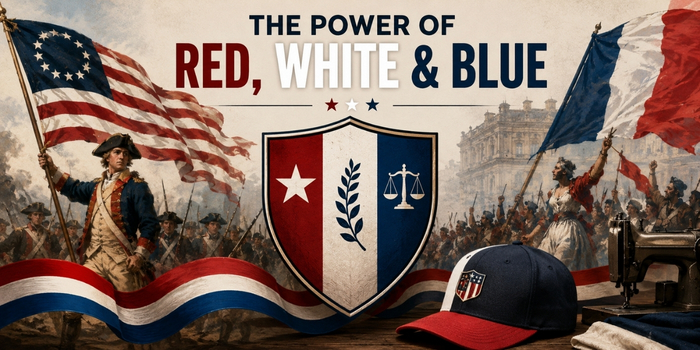
The founders deployed red, white, and blue because the high-contrast combination created an unmistakable visual system that anyone could reproduce. The Continental Congress Secretary, Charles Thomson, cemented the ideological meaning of this palette in 1782. He designated red for hardiness and valor, white for purity and innocence, and blue for vigilance, perseverance, and justice. But the true genius of the triad lay in its physical execution. Early American craftspeople faced severe resource limits. They needed a graphic language they could manufacture quickly.
Following the success of the American Revolution, this specific color triad transcended national borders to become the universal visual shorthand for liberty. When other nations launched their own democratic movements, they intentionally borrowed this high-contrast palette to brand their uprisings. The French Revolution famously adopted the tricolor to visually signal their push for democracy.
Eagles, Stars, and Stripes: Designing for Scalability
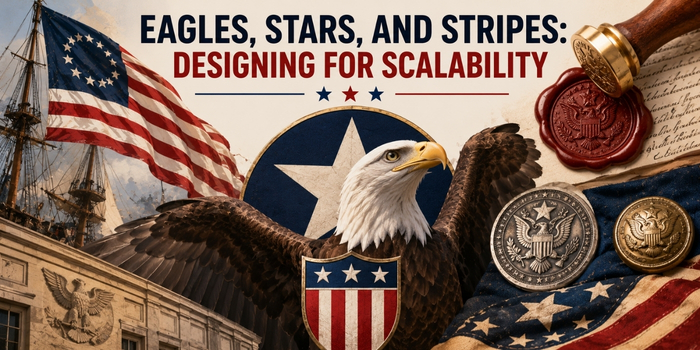
The foundational American icons—the eagle, star, and stripe—stand as a historical masterclass in scalable visual communication built for primitive manufacturing.
The founders designed a functional, highly adaptable toolkit meant to survive the resource limitations of eighteenth-century colonial America. They needed symbols that ordinary citizens could reproduce quickly and accurately. They relied heavily on the five-pointed star because its mathematical symmetry enabled everyday artisans to cut and paint it flawlessly without losing its sharp, recognizable identity.
They combined these geometric stars with the severe, structured contrast of thirteen stripes. These parallel lines acted as highly effective environmental graphics. They generated an intense visual rhythm that remained completely legible from vast distances, allowing sailors and soldiers to identify friendly forces instantly across open water or rugged terrain. To complete this visual system, leaders integrated the Bald Eagle to project federal power.
Cross-Medium Challenge
Eighteenth-century America lacked a central communication network, requiring visual symbols to do the heavy lifting of political unity. The American Independence Designs had to translate perfectly across every conceivable material crafted by colonial hands. A shipwright had to hoist massive, vividly painted stars on a towering wooden mast to claim territorial waters.
This extreme need for physical adaptability resulted in an incredibly durable national language. Early leaders discarded intricate, hard-to-reproduce aristocratic crests in favor of sharp lines and distinct silhouettes. This practical choice empowered everyday citizens to reproduce the nations identity using whatever materials they had available. A weaver could stitch the patriotic motifs into a homespun quilt, and a stonemason could carve them into a federal buildings facade.
The Typography of Independence
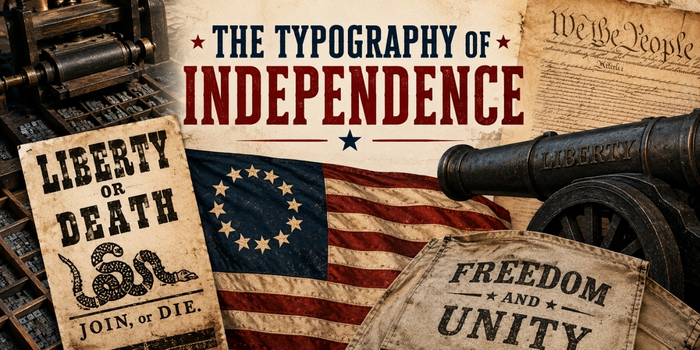
Early American printers utilized the severe limitations of their primitive presses to invent a distinctive visual style that successfully unified thirteen fractured colonies into a single political force.
Colonial print shops operated far from the refined manufacturing centers of London, forcing local artisans to improvise with raw materials and heavy lead type. This isolation birthed a highly tactile, unmistakable print shop aesthetic that drove the American Revolution. Printers weaponized heavy woodcut illustrations to distribute high-contrast, easily digestible political propaganda to the masses. They carved these bold images with rough edges to ensure the graphics remained legible even when hastily printed on low-quality paper.
From Paper to Physical Goods
The urgent, heavy typography of the American Revolution rapidly escaped the fragile printing press and embedded itself directly into the physical infrastructure of the new nation.
Revolutionary ideas required far more permanence than a rapidly deteriorating paper broadside could provide. As the colonies violently transitioned into a sovereign republic, citizens required their new visual language to survive the rugged realities of daily life. They took the authoritative print shop aesthetic and actively weaponized it for the real world.
Local craftsmen successfully adapted the distinct, heavy lettering of political posters into highly durable materials. Carpenters meticulously chiseled the stark, high-visibility fonts deep into wooden tavern signs and formal civic buildings. Metalworkers poured molten iron into precise sand molds that cast these exact letterforms into military cannons, ship anchors, and essential tools.
Reimagining Americana in Modern Creative Culture
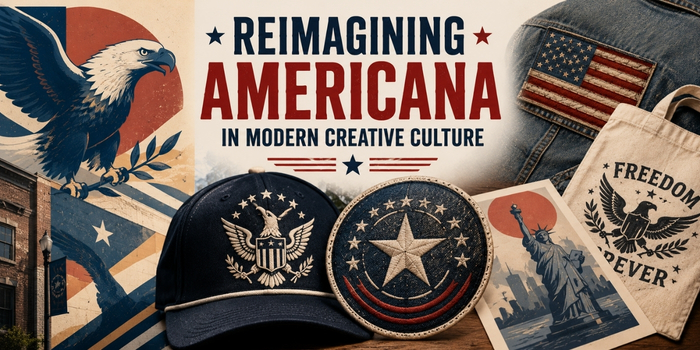
Contemporary artists and civic designers constantly modernize the 250-year-old symbols of the American Revolution. They deliberately adapt the foundational graphics of 1776 to engage with modern cultural movements rather than copying rigid historical templates. This active reinterpretation ensures that the visual origins of the country continue to communicate powerful ideas today.
Visual historians execute this modernization through several distinct, practical design techniques. They strip away the overly complex layers of traditional eighteenth-century heraldry, transforming intricate colonial emblems into clean, minimalist shapes that resonate instantly with contemporary citizens. Many public artists intentionally abandon the traditional red, white, and blue palette, substituting muted tones or vibrant modern colors to visually represent a diverse republic. Additionally, they seamlessly merge highly detailed vintage eagles with modern, unadorned typography to create compelling civic artwork.
This relentless creative reinvention keeps the visual language of the founding era deeply relevant to modern society. By actively updating these historic motifs, new generations confidently claim the original symbols of American independence as their own.
Tactile Art and Pop Culture
We understand the American Revolution not just through textbooks, but through the physical weight of the objects that carry its symbols. Today, cultural preservers and everyday citizens keep this vital history alive through physical mediums that bridge the centuries.
Modern creators utilize heavy threadwork and dense fabric manipulation, similar to techniques used in workwear embroidery digitizing, to keep historical motifs in constant public circulation. Textile artists stitch thick yarn into rugged canvas, using traditional appliqué, woven patches, and intricate embroidery work to echo the homespun garments of early patriots.
Everyday citizens interact with the monumental design language of the United States directly through these physical goods. A smooth glass screen completely fails to capture the rugged, enduring nature of the American republic.
Conclusion
Exploring American Independence Designs History proves that powerful symbols live off the screen. You feel this raw energy perfectly inside Vintage American Typography. Early Americans guaranteed these graphics survived by turning them into durable physical goods. Today, you can wear that exact legacy.
With years of experience, Cre8iveSkill leads in professional embroidery digitizing. We craft authentic American Heritage Aesthetics through premium custom embroidery.
