Table of Contents
A To Z Glossary on Embroidery Digitizing
Embroidery digitizing is a process that converts artwork into a stitch file that embroidery machines can read. Every design involves different stitch types, settings, techniques, and file formats that affect the final embroidered result. Whether you are a beginner, apparel business owner, designer, or looking for professional embroidery digitizing services, understanding common embroidery terms helps you communicate better and create high-quality embroidery designs.
This complete A to Z embroidery digitizing glossary explains important terms used in the embroidery industry.
A to Z Embroidery Digitizing Glossary
A – Embroidery Digitizing Terms
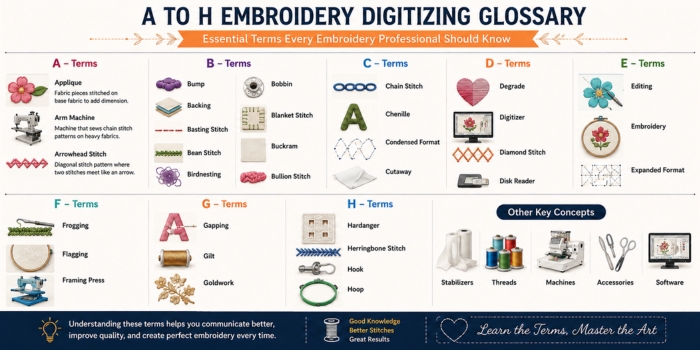
Applique:
An old design technique in which cuttings of particular shapes, motifs, or patterns from pieces of fabrics are stitched onto another material to add dimension.
Arm Machine:
Arm machine is a stitching machine to automatically sew chain stitch design patterns or narrow-width tubular seams on heavy fabrics like denim and jeans.
Arrowhead Stitch:
It is a type of stitch that has a diagonal stitching pattern that has a zigzag effect. In this type of embroidery, two straight stitches meet to create the shape of an arrowhead.
B – Embroidery Digitizing Terms
Bump:
A bumpy or raised style of stitching that sits on top of the base rows in the previous round of crocheting, creating a three-dimensional effect.
Backing:
Any woven or non-woven material, also known as a stabilizer, placed permanently or temporarily underneath the base fabric to be embroidered for stability and support.
Basting Stitch:
Basting or tacking refers to quick and temporary stitches made with the purpose of removing them later to hold a seam in place until proper final stitches.
Bean Stitch:
Three or more stitches are made back and forth repeatedly between two specific penetration points for outlining more boldly and strongly than a simple run stitch.
Birdnesting:
Birdnesting refers to threads bunching up in a messy knot below the needle plate while embroidering. It leads to broken threads, improper stitches, and uneven tension.
Bobbin:
A small reel or spool wound with the thread meant for lockstitch machines. They can also be wound on sewing machines or sold pre-wound from the supplier.
Blanket Stitch:
A kind of stitch that reinforces the edges of blankets and other thick fabrics. It can also be used as a decorative stitch for borders and edges.
Buckram:
A piece of stiff and coarse backing fabric is used to stabilize a softer material to hold it erect and show the embroidery pattern on the front side.
Bullion Stitch:
It is a decorative embroidery technique where the thread is twisted several times around the needle before inserting it into the fabric. It adds dimension to the embellishment.
C – Embroidery Digitizing Terms
Chain Stitch:
It is an embroidery technique formed by a series of loops that resembles a chain pattern made by inserting the thread from the bottom of the fabric.
Chenille:
It is a form of embroidery, also known as loop piling, using heavy yarns like wool or acrylic to form loop stitches on the upper side of the fabric.
Condensed Format:
T is a method of saving a digitized design in its skeletal form. The number of stitches between the defined points is determined afterward after scaling the size.
Cutaway:
A permanent embroidery stabilizer that supports a softer fabric on top to help with embroidery and make it look erect and prominent.
D – Embroidery Digitizing Terms
Degrade:
A technique of embroidery that involves color shading. The colors in the design shade from the darkest pigment to the lightest without being demarcated.
Digitizer:
Someone responsible for operating and supervising the computer program or the embroidery digitizing software that digitizes an embroidery design and stores it for future use.
Diamond Stitch:
A decorative crochet knitting done using double crochet rows and post stitch rows is arranged in a manner that appears to make diamond shapes.
Disk Reader:
It is an internal or external device fed into the programming of a digitized embroidery machine to determine the sequence of needle movements and produce the desired design.
E – Embroidery Digitizing Terms
Editing:
It is the process of changing parts of a design to modify the final product through a computerized embroidery editing program that allows scaling, editing stitches, and making combinations.
Embroidery:
The art of embellishing a piece of fabric using threads by following a stitching pattern or sewing technique to produce a particular design or pattern is called embroidery.
Expanded Format:
A digitized design format where individual stitches are set to a specific size and the stitch count is constant. The designs cannot be scaled up or down without distortion.
F – Embroidery Digitizing Terms
Frogging:
Frogging is an act of having to unpick or undo the knitting or crocheting pattern due to an error made in between or with the intention to change the design.
Flagging:
The distorted up and down motion of the fabric, akin to a flag, due to incorrect hooping, lack of embroidery stabilization, and misadjusted presser foot.
Framing Press:
The machine that helps with the framing and hooping process while carrying out the embroidery. It provides back support and maintains the tension of the fabric.
G – Embroidery Digitizing Terms
Gapping:
It is a flaw in the embroidery where the base fabric is visible amidst the design because of an error causing a gap in the stitching technique.
Gilt:
Gold-painted metal threads or textile threads having golden metal leaves wound around them. The threads can be silver or copper, too other than imitation gold.
Goldwork:
The art of embroidery using gold-painted metal threads or metal leaves wound around textile threads, secured to the fabric using a second silk thread.
H – Embroidery Digitizing Terms
Hardanger:
It is a form of whitework embroidery made with white thread over white, even-weave linen cloth. It follows the counted-thread technique as well as the drawn-thread method.
Herringbone Stitch:
A style of stitching used in embroidery, crochet and knitting that follows a pattern resembling the bones extending outwards from the spine of a herring fish.
Hook:
Equipment that holds the bobbin case in the embroidery machine, which rotates twice, meeting the top thread at a set time and distance to complete each stitch.
Hoop:
A plastic, wooden, or a metal device that grips the base fabric for the embroidery between the outer ring and the inner ring to maintain adequate tension.
I – Embroidery Digitizing Terms
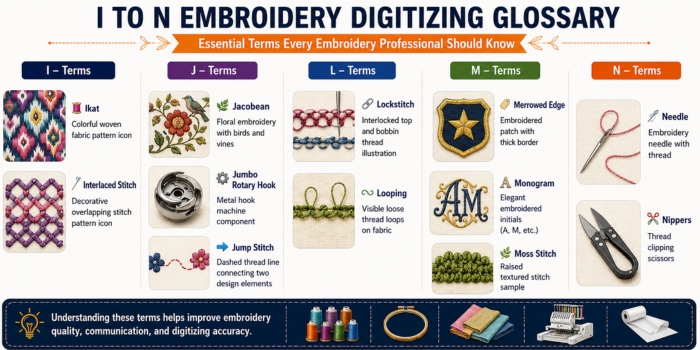
Ikat:
An Indonesian form of dyeing and weaving technique where the yarn is made to resist the dyeing before the actual process of weaving and coloring.
Interlaced Stitch:
A series of stitches where a second or a third thread in interlaced through the first line of foundation stitches without passing through the base fabric.
J – Embroidery Digitizing Terms
Jacobean:
A style of embroidery named after the period of King James I of England consisted of elaborate and ornate flowers, leaves, vines, birds, and animals.
Jumbo Rotary Hook:
A large sized hook in the bobbin driver present in lockstitch sewing machines, which continuously rotates to hook the upper thread when it crosses the 12 o’ clock position.
Jump Stitch:
The moving of the pantograph and the rotating of the sewing head without any movement of the needle. It helps to move from one point to the other in the embroidery.
L – Embroidery Digitizing Terms
Lockstitch:
A stitch formed by interlocking the needle thread with the bobbin thread. The machine loops together with the two threads on each side of the fabric.
Looping:
Loops formed on the top surface of the embroidery pattern due to improper tension of the top threads or as a result of skipped stitches.
M – Embroidery Digitizing Terms
Merrowed Edge:
A heavy border sewn over the edges of the patch stitched on a piece of fabric. It is generally done in geometrical shapes like ovals, squares, and circles.
Monogram:
A subset of embroidery where small patterns or motifs, such as initials or logos are sewn onto a piece of fabric as a stamp or decoration.
Moss Stitch:
A form of embroidery, also known as chenille or loop piling, made using heavy yarns to form loop stitches on the upper side of the fabric.
N – Embroidery Digitizing Terms
Needle:
The device used to form the stitches in an embroidery process, carrying the thread through the fabric by passing through various points using various techniques.
Nippers:
Nippers, also known as thread clippers, are small scissors with springs that can be used to clip threads using only the thumb finger and the forefinger.
O – Embroidery Digitizing Terms
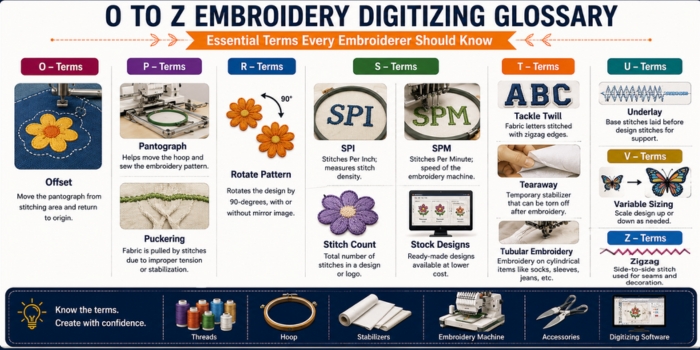
Offset:
A method used for placing and attaching appliques by moving the pantograph from the stitching area in a pre-set movement and returning to the origin.
P – Embroidery Digitizing Terms
Pantograph:
A section of the embroidery machine resting on the top of the table that helps to move the hoop and carry out the process of sewing the embroidery pattern.
Puckering:
The fabric being pulled by the stitches in the embroidery because of improper tension caused by insufficient backing support and stabilization, stretchy fabric, and loose hoops.
R – Embroidery Digitizing Terms
Rotate Pattern:
A programmed parameter set on a computerized embroidery machine that rotates the design by 90-degrees, with or without making a mirror image of the design.
S – Embroidery Digitizing Terms
SPI:
An abbreviation for Stitches Per Inch of an embroidery machine. It is expressed by measuring the number of lengths of threads present within one inch in embroidery.
SPM:
An abbreviation for Stitches Per Minute of the embroidery machine, referring to its running speed, or the number of stitches it can sew in one minute.
Stitch Count:
A count of the number of stitches present in a logo or a particular embroidery pattern. The stitch count increases with the size of the logo or design.
Stock Designs:
Digitized embroidery designs available readily to be stitched onto fabrics through embroidery machines for a vast number of customers, available at a cheaper rate than custom-digitized designs.
T – Embroidery Digitizing Terms
Tackle Twill:
Cuttings of letters and numbers from rayon twill fabric stitched onto clothes, especially sports jerseys with adhesive backing. The edges are then stitched in a zigzag pattern.
Tearaway:
A non-woven thin material placed temporarily under the back surface of the fabric being used for embroidery. The material can be torn off after completion.
Tubular Embroidery:
Embroidery is made using a computerized embroidery machine that helps sew designs on cylindrical or tubular garments like socks, sleeves, jeans, etc., after assembling the garment.
U – Embroidery Digitizing Terms
Underlay:
The skeleton or basic framework stitches of an embroidery design. These stitches are made before the main decorative stitches to provide support or foundation to the design.
V – Embroidery Digitizing Terms
Variable Sizing:
The ability to determine the size of a particular design on a digitized embroidery machine by scaling the size up or down as per need.
Z – Embroidery Digitizing Terms
Zigzag:
A side-to-side stitching pattern used particularly for seams and decoration. The back-and-forth stitching technique is helpful in cases where a straight stitch isn’t enough for reinforcing.
